A guide to the total solar eclipse

A total solar eclipse is imminent in Spain. Over the next few days, people from all over the world will be flocking here to witness a historic astronomical event. And yet there will still be plenty of people who will only hear about the eclipse at the last minute, feel an unbearable case of FOMO, jump in the car, and end up not seeing the eclipse because they’re stuck in a monumental traffic jam, or behind a mountain that blocks the Sun.
So, if you don’t want to be one of those people, I’m going to tell you everything you need to know to be able to see the eclipse — and what not to do so you don’t miss it. I’ll also tell you what you can do if you’re late to this video and 12 August has already passed. And finally, I’ll tell you about another very special solar eclipse, and show you the most spectacular image of an eclipse that humanity has ever witnessed.
Introduction
Let me start with a confession: I have never in my life seen a total solar eclipse. The only solar eclipse I have seen happened on a Monday morning, on 3 October 2005. I watched it from the physics faculty, with my colleagues. And the truth is, the eclipse came and went without much fanfare. Meh.
But where I was, in Seville, the Sun never fully disappeared from the sky — in other words, it wasn’t a total eclipse. And from what people say, the experience is completely different. So I really can’t wait to see what total solar eclipses are capable of. Have you ever seen one? If so, share your experience in the comments.
The last time a total solar eclipse was seen in Spain was in 1959. But it was only visible from the Canary Islands. And the last one on the mainland was on 17 April 1912. But that was an odd eclipse, visible for just a few seconds from the northwest, and only barely. On top of that, ironically, that eclipse was eclipsed by another historic event that happened a couple of days earlier: the sinking of the Titanic. So the last decent total solar eclipse seen on the Spanish mainland was in 1905 — that is, 121 years ago.
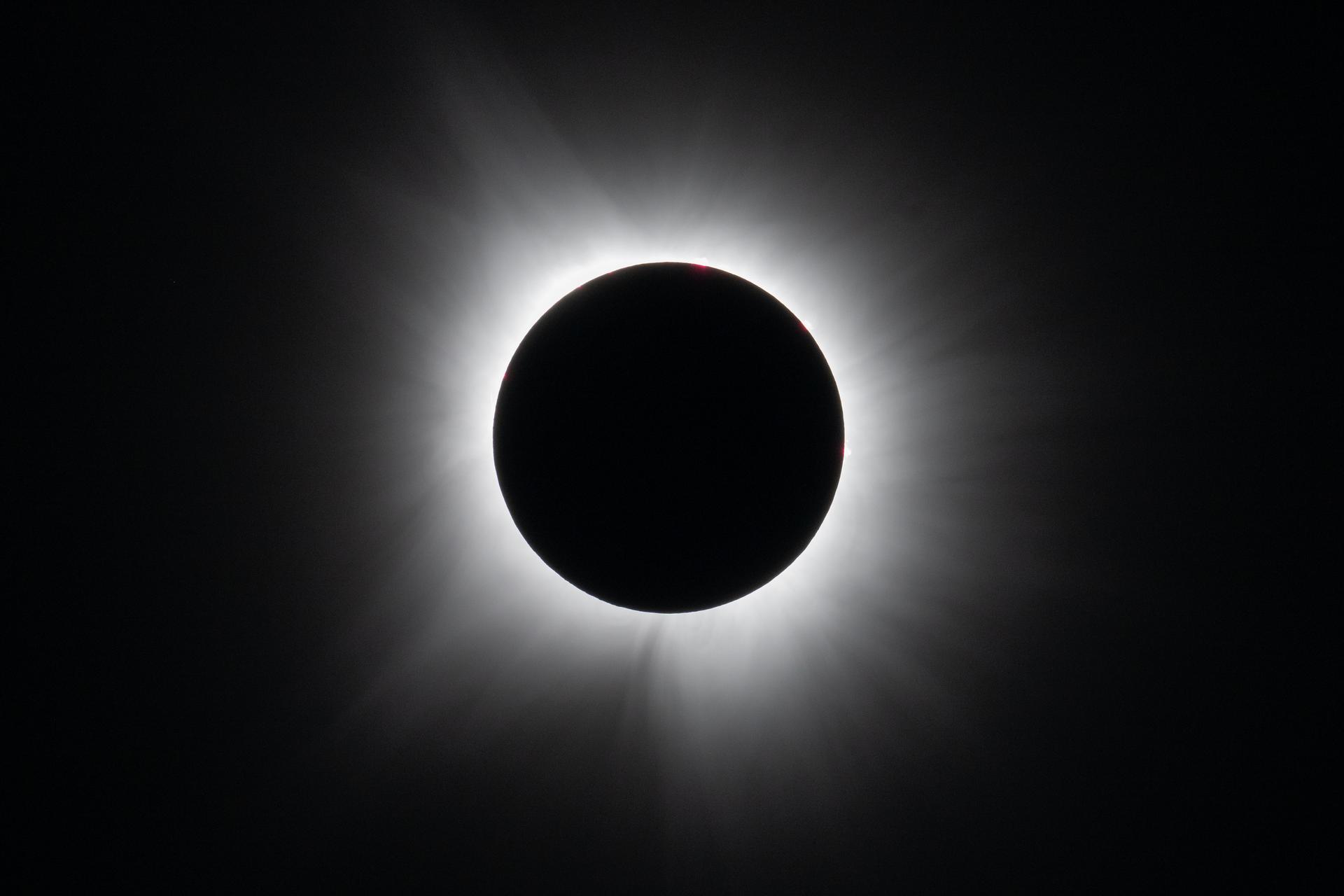
This Wednesday we will have a total solar eclipse: an event where the sky suddenly goes dark, you look up, and you find what looks like a black hole where the Sun should be. What’s more, the Sun, very low on the horizon, will be completely covered by the Moon, letting us see the solar corona in sunset colours.
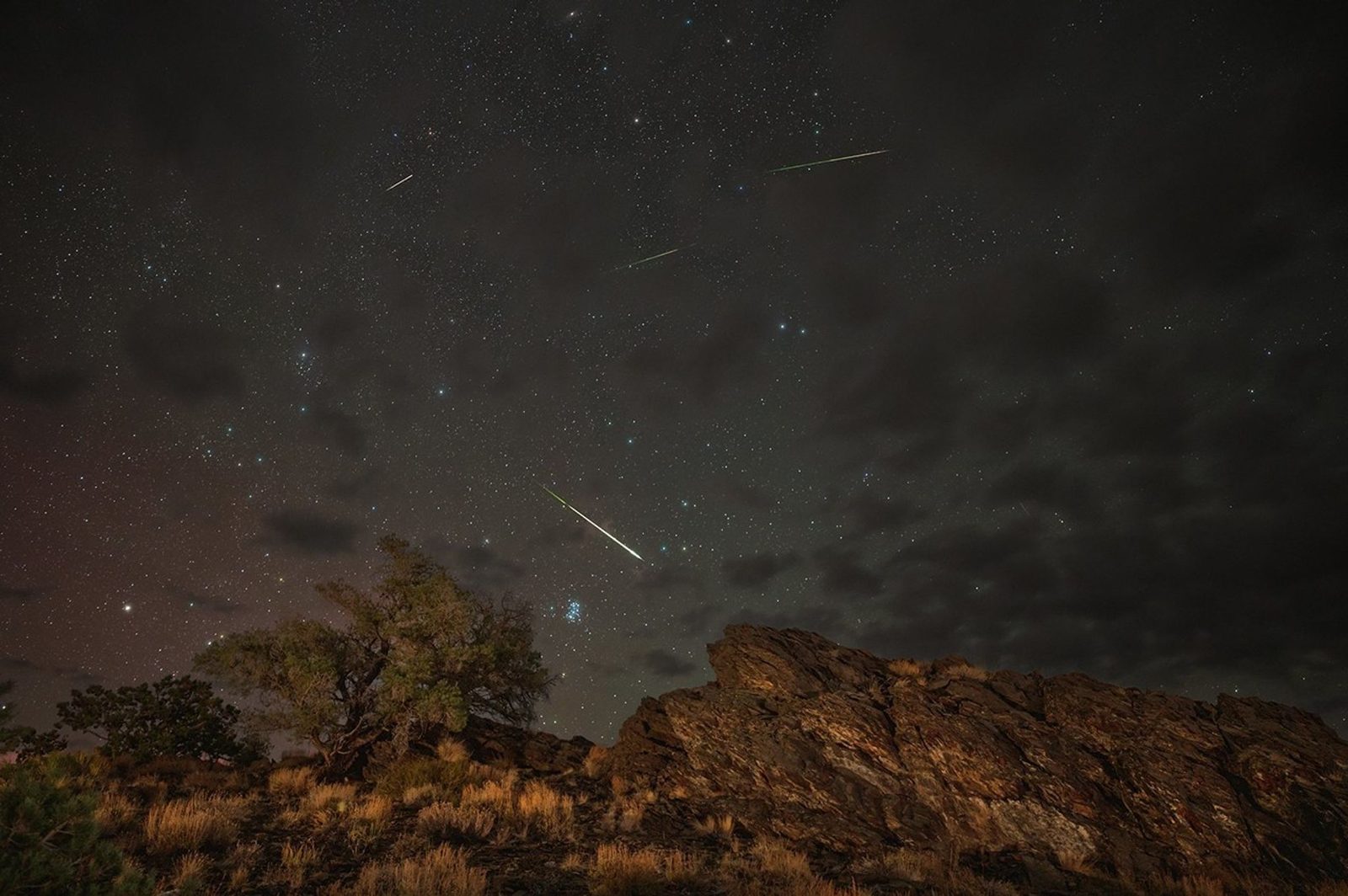
And as if that weren’t enough, once the Sun sets we’ll get another celestial show: a meteor shower. That night the Perseids will be at their peak activity, coinciding with a new Moon, which will be kind enough to leave us a nice dark sky in which to watch shooting stars.
But before getting into the practical questions of how to watch it, let me explain very briefly what an eclipse is.
What is an eclipse?
An eclipse happens simply because the Moon goes around the Earth and, every now and then, the Earth, the Moon and the Sun line up.
In short, as my friend Katie Mack explained:
- Sun – Earth – Moon → Lunar eclipse.
- Sun – Moon – Earth → Solar eclipse.
- Earth – Sun – Moon… Apocalypse.
For the rest of the episode we’ll focus on the one that concerns us: the solar eclipse. Not all solar eclipses are the same. There are three main types:
- The least exciting one is the partial solar eclipse: it happens when you see the Moon pass in front of the Sun, but without the two being fully aligned. In other words, the Sun’s glare always sticks out on one side.
- When the Moon is farther from the Earth and lines up with the Sun, what we see is an annular eclipse, where the Sun sticks out all around the Moon, drawing a ring.
- And when the Moon is closer to the Earth and lines up with the Sun, then yes, we get a total solar eclipse, where the Moon completely covers the Sun, making the sky temporarily go dark.
Technically there is also the hybrid solar eclipse, much less frequent, which is partly annular and partly total.
Now, let’s get practical. These are the three golden rules for watching the total solar eclipse.
1. Choose a spot with good visibility
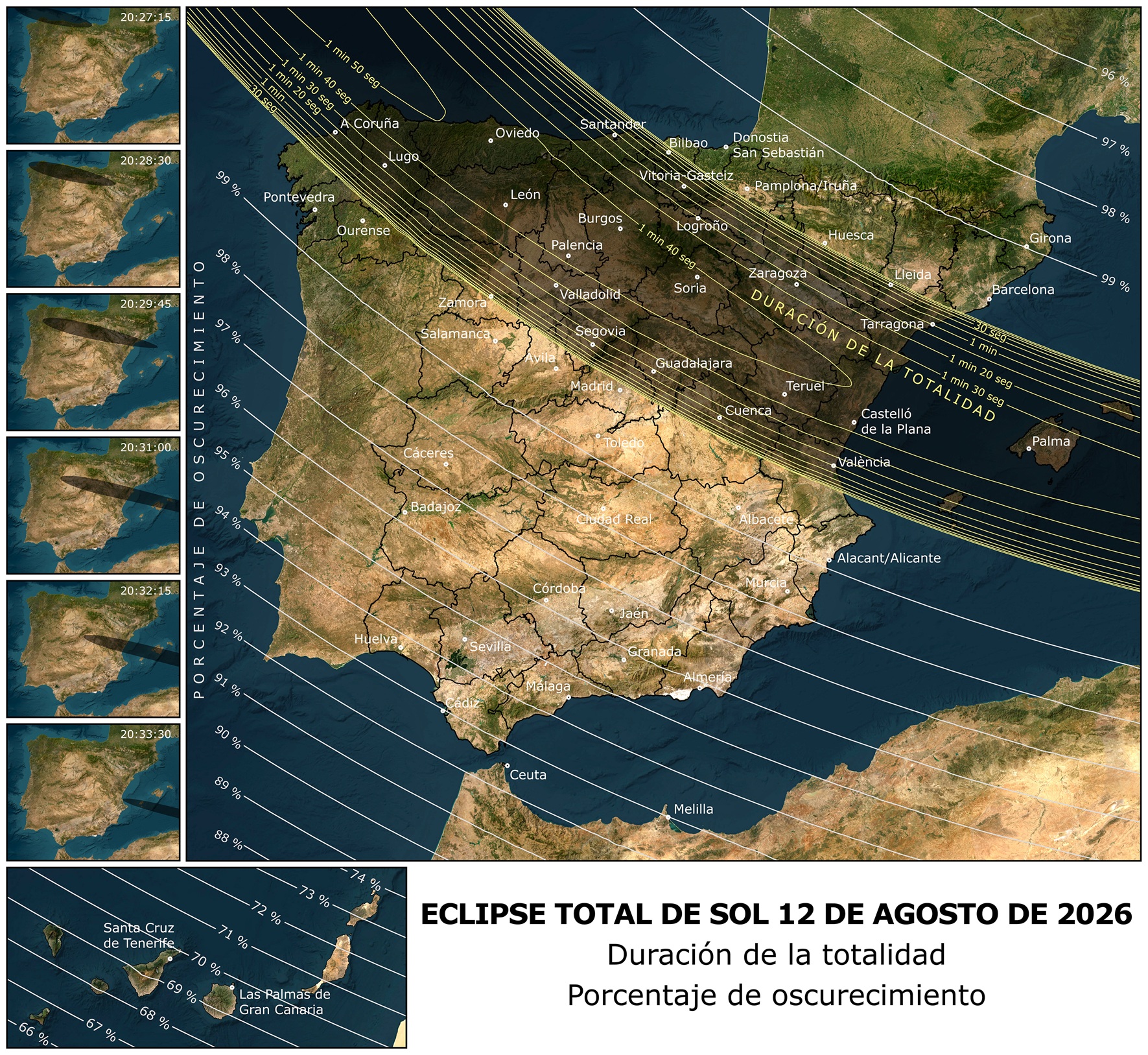
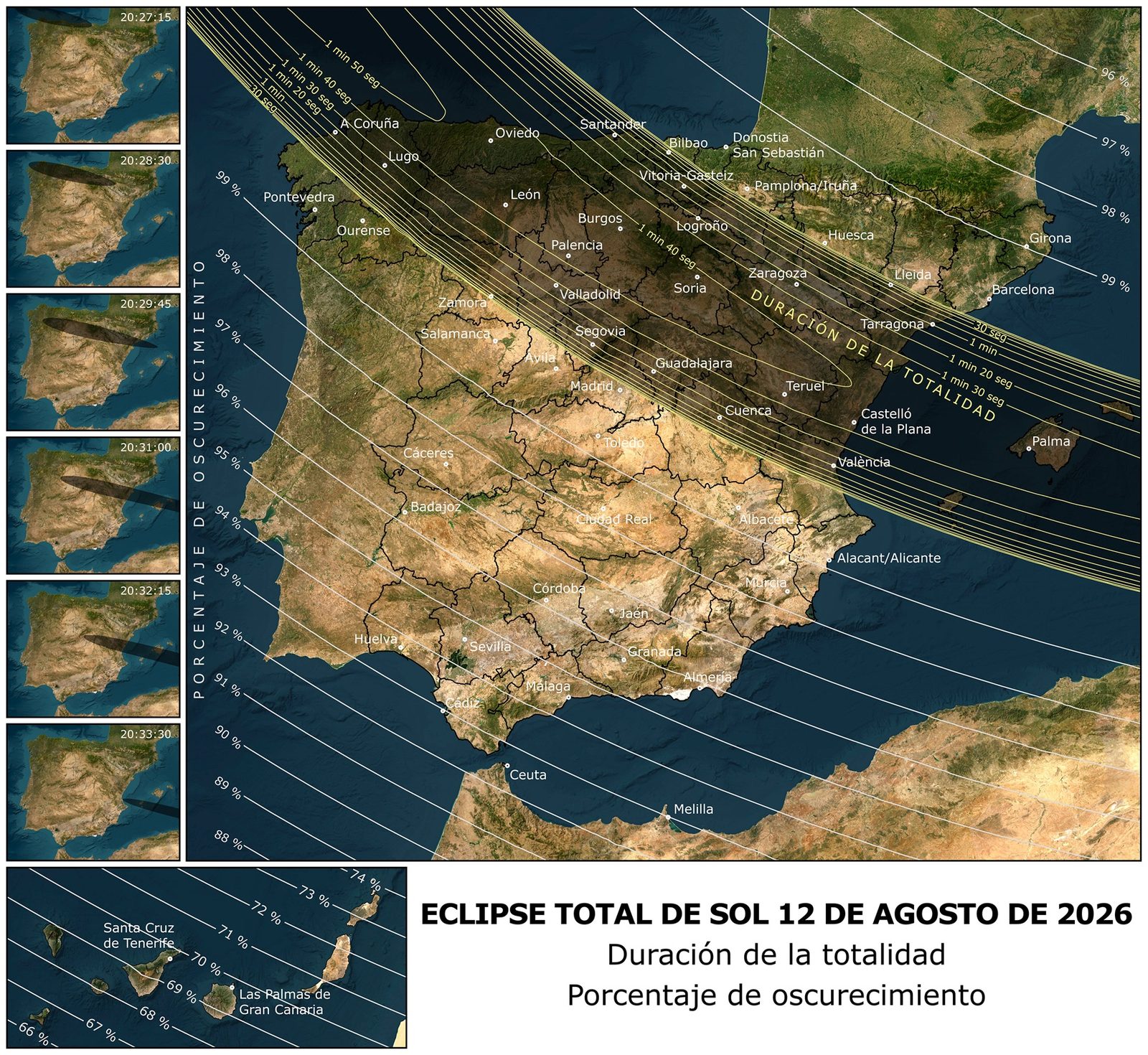
This map from Spain’s National Geographic Institute shows the band where the eclipse will be total. A Coruña, León, Zaragoza, Valencia… The map also shows how long the Sun will be completely hidden by the Moon. For example, in Palma de Mallorca it will be a minute and a half. In Tarragona, 1 minute. Outside that band, you see percentages — 99, 98, 97%… That means the Sun never gets fully covered. And since the Sun is so bright, even seeing just a tiny sliver of it is enough to prevent us from seeing the solar corona.
There is another map where you can see all this information in much more detail, interactively. On this map, the shaded band shows where a total eclipse will be visible. Barcelona, for example, is outside it. If you click on Barcelona, and then on “infographic”, you’ll see in more detail what to expect at each hour. As you can see, at the peak of the eclipse, a little bit of the Sun will still be visible. If instead we go to Lleida, which is inside the zone of totality — boom! There the Sun does appear completely hidden, surrounded by its corona.
So, anywhere on the mainland, the eclipse will start at around 19:30 and end at around 21:30, or whenever the Sun sets. But the most interesting part, when the Sun is completely hidden, will happen in a much shorter window, between 20:25 and 20:35. On the map I mentioned earlier, by moving the slider at the bottom, you can see the exact time at which the Sun will be totally hidden at each location.
Okay, so you’ve chosen a spot from which the eclipse can be seen. That’s it, right? Not so fast! Keep in mind that this eclipse will happen very close to sunset, when the Sun will be very low, near the horizon. So you have to make sure there are no mountains or buildings to the west that could hide the Sun. How can you find out?
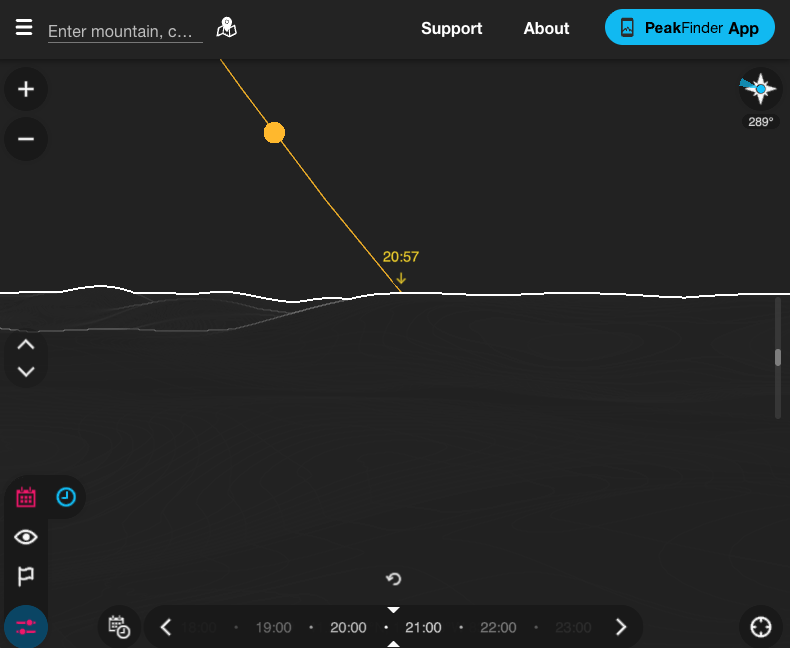
On the map from before you can see some shaded areas. Those are the shadows of mountains at the time of the eclipse. So avoid being in an area blocked by mountains. If you want to look into this in more detail, you can also use another website called peakfinder.com:
- On the map, select your spot.
- Drag the image until the compass points west (leaning slightly northwest).
- Select the date, 12 August 2026, and then the time, 20:35.
There you will see a yellow line representing the Sun’s trajectory. You will also see the position of the Sun at that particular time. What you need to make sure of is that between 20:25 and 20:35 the Sun is still visible in the sky, and not hidden behind mountains.
But we’re not done yet! There may be no mountains, but there can also be buildings, monuments, or trees. For that, we can turn to Google Maps. If you zoom in on an area that has Google Street View images, you can go directly to the place you had in mind, and rotate the map until you’re pointing west. At the bottom right, by the way, you can see the date the images were taken. If that date is from a few years ago, be careful in case someone has built a skyscraper in front of you since then. And if the place doesn’t have Google Street View images, you can also try viewing the map in 3D, to get an idea of what’s around.
And finally, the only thing left is… good weather. And there’s very little we can do about that. On the map from before you can turn on the forecast from AEMET (Spain’s meteorological agency). Ideally there will be no clouds; but if there are, the worst ones are low clouds. In other words, on this map, white is best, and green is worst. As the day approaches, the weather forecasts will become more reliable. Also worth a look is this other map, where you can see how often the sky is clear around 12 August, based on historical data from 2010 to 2025. In this case, blue is best, and red is worst.
2. Plan the trip well
I know people who have been planning for this eclipse for over a year! But even if you’re extremely well prepared, things can always go wrong at the last minute.
You need to make sure you’re at your chosen spot at the right time. Keep in mind that the total occultation of the Sun lasts less than two minutes, so, if you don’t want to be late, you have to leave home well in advance.
Unfortunately, that “well in advance” is no small feat. The DGT (Spain’s traffic authority) already expects between 400,000 and 1.5 million additional trips on top of a holiday period that already sees heavy traffic. Plan to leave home many hours before the eclipse, or even the day before. If you can go by train, even better. And if you’re taking the car, check for traffic jams before leaving, and assume there will be much more traffic than usual.
But the worst part won’t be getting there — it will be getting back. The eclipse will happen just before sunset, so there will be thousands of cars driving home at night at the same time. If you can spend the night of the 12th somewhere, not only will you get to enjoy the Perseids, but you’ll also avoid traffic jams and potential accidents.
And of course, make sure to bring water, food, mosquito repellent, and… eclipse glasses!
3. Buy eclipse glasses
This may be the last eclipse you see in your life. But what we don’t want is for the eclipse to also be the last thing you see in your life. So, to be able to look directly at the Sun, you need glasses certified under the ISO 12312-2 standard.
Don’t grab some dodgy glasses from a sketchy corner of the internet. Buy them from a trusted place — they’ll cost a few euros at most. I bought mine at the Còsmik shop in Barcelona.
If you’re inside the band where the eclipse will be total, you’ll see that at a certain moment beads of light form along the edge of the Moon, caused by sunlight passing between the Moon’s mountains and craters. And right when the last bead disappears, the Moon will completely cover the Sun. At that moment you can take off your glasses without fear, and see the solar corona with your own eyes. But don’t get distracted: as soon as the Sun starts peeking out from the other side of the Moon, you have to remember to put your glasses back on.
And if you’re outside the zone of totality, what you’ll see is a partial eclipse, and you’ll have to keep your glasses on the whole time.
And if you can’t see it this time…
If, unfortunately, you’re watching this video late, you haven’t planned anything, and you’re not in an area with good visibility… please don’t just recklessly jump in the car hoping to get lucky, squinting up at the Sun. If you don’t have a spot planned and enough time to get there, you’re better off staying home, rather than risking hours in a traffic jam in the middle of nowhere.
If that’s your case, or if 12 August has already passed you by, I have good news: in Spain we don’t just get one solar eclipse — we’re going to experience a trio of eclipses in three consecutive years. On 2 August 2027 there will be another total solar eclipse in Spain (visible from Cádiz), and on 26 January 2028 there will be yet another solar eclipse (although that one will be annular).
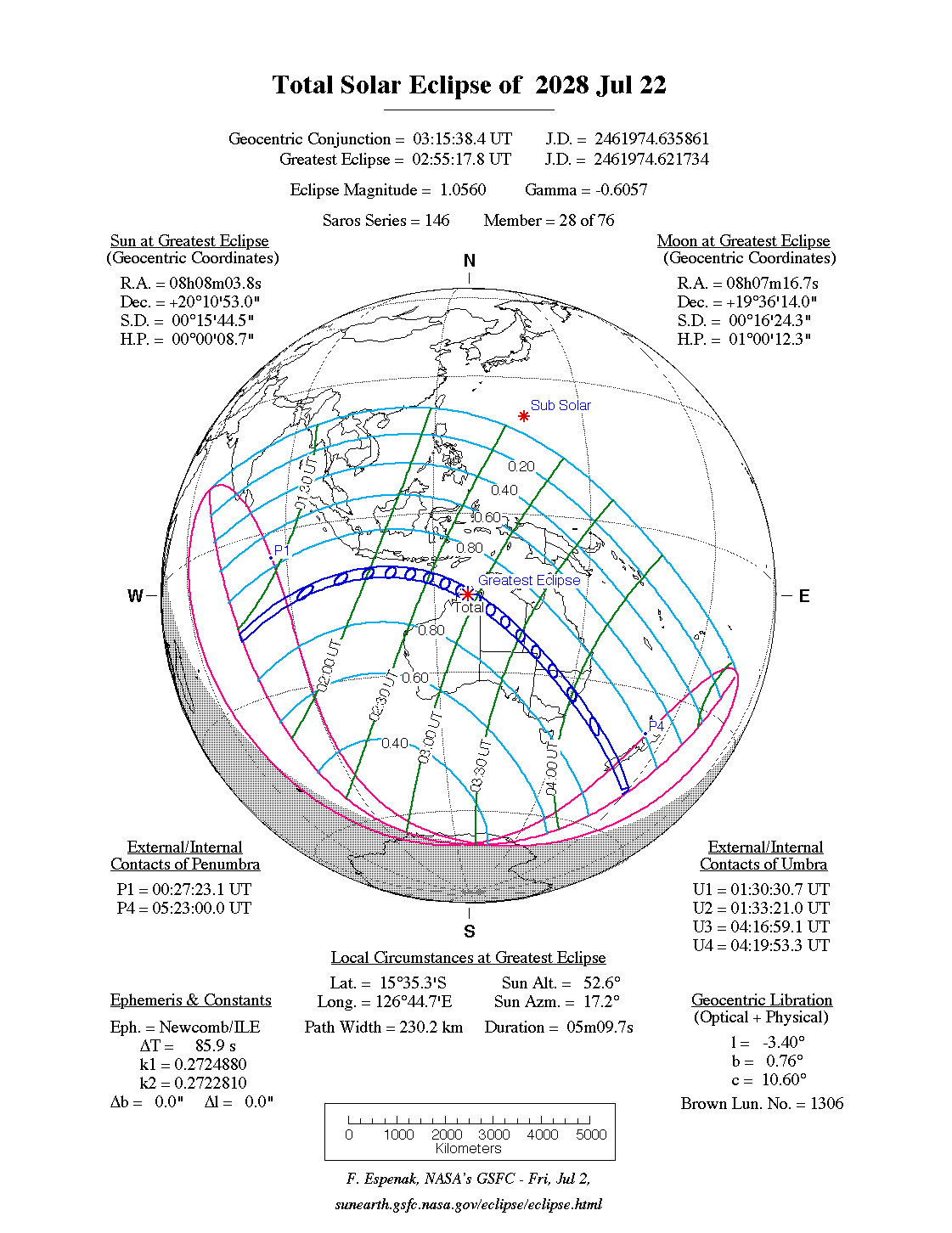
If for some reason you end up missing all three solar eclipses in Spain over the next few years, the next total solar eclipse here will be in 2053. Even so, you can always travel somewhere else in the world to see other solar eclipses. On this NASA website you can see the list of all the eclipses predicted for the rest of the decade. For example, in 2028, there’s a total solar eclipse in Sydney, Australia.
The most spectacular eclipse ever seen
Before finishing, I wanted to show you the photo of the most impressive solar eclipse ever witnessed by humanity. It’s a very special total solar eclipse, where it’s not the Moon covering the Sun, but the Earth. Seen from space, that is.
It’s a photo taken a few months ago from the Artemis II spacecraft. This is what the Earth looks like at night, lit only by the stars and by the full Moon.
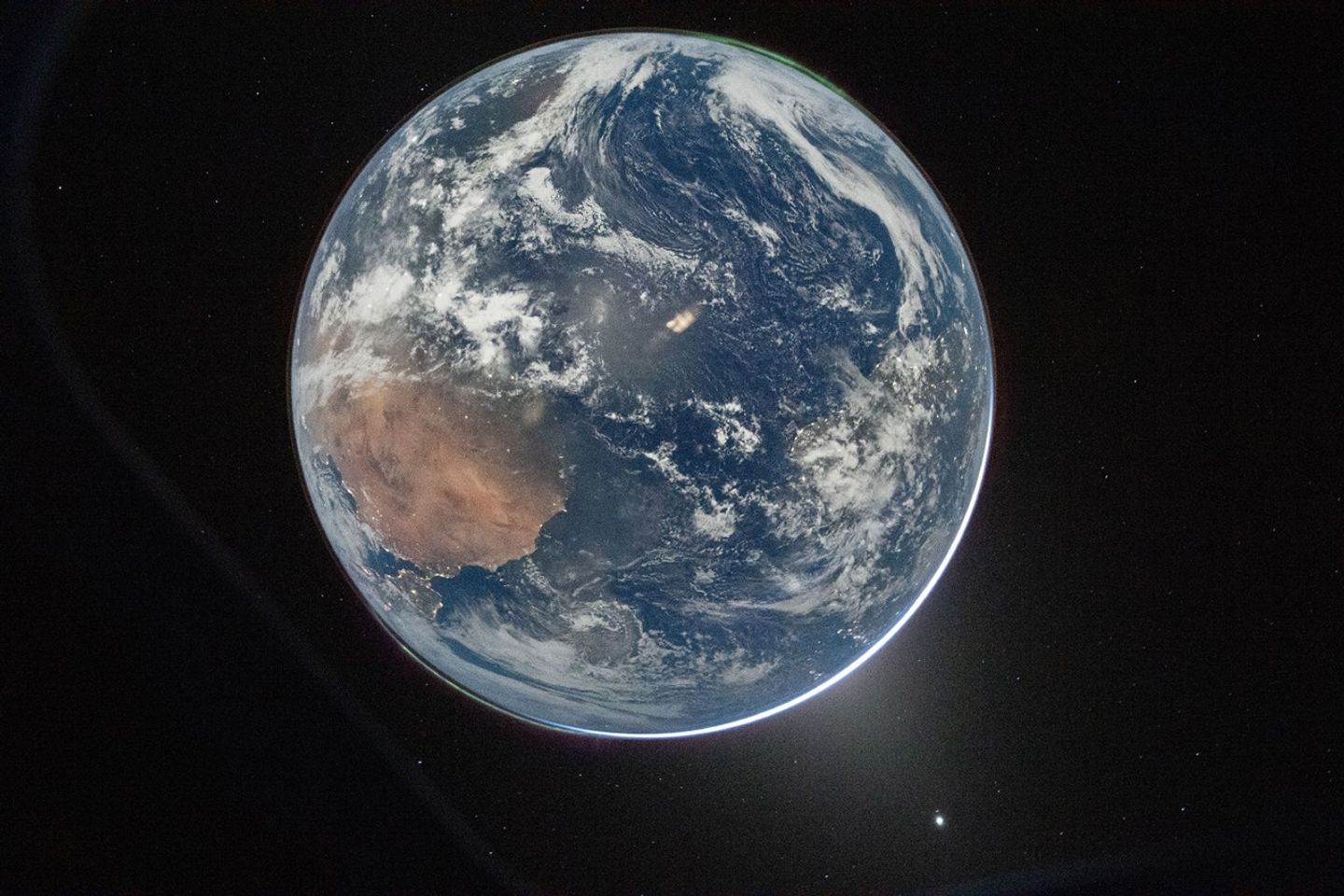
That bright dot in the sky is Venus. That flash on the edge is the Sun itself, peeking out from behind the Earth. And that halo of light is the so-called zodiacal light, caused by sunlight reflecting off interplanetary dust. At the poles you can also see the colours of the southern and northern auroras. And in the middle of the Earth, that greyish shadow visible between the clouds is the reflection of the full Moon on the Atlantic Ocean.
Down there you can see Spain. Yes, upside down compared to how we usually see it on maps. And that bright dot is the sum of all the lights of millions of people in Madrid during the night of Maundy Thursday 2026.
In a previous episode we talked about the so-called “overview effect”: a fundamental shift in the way reality is perceived, experienced by some astronauts upon seeing planet Earth from the outside.
For those of us here on Earth, the eclipse can be a moment of overview effect. Because there is one more thing that makes solar eclipses so special: it’s a moment when millions of people — with different dreams, fears, beliefs and political preferences — come together to look in the same direction. It’s a moment of unity, awe, and humility, when we set aside our mundane everyday worries to pay attention to what happens beyond our little blue dot.
So I invite you to use that moment not only to enjoy the astronomical show, but also to reflect. Is there anything more worthwhile in life than trying to make this world of ours a better place?
I hope you enjoy the eclipse, and that you found this video interesting. If so, leave me a comment, a little thumbs up, and subscribe to my channel. I don’t know whether I’ll ever see another total solar eclipse in my life, but what I do hope is to see you again in the next episode of AltruPhysics.