About me
I’m Pablo Rosado: astrophysicist by training, data scientist by profession, and science communicator by passion. This page explains how I got here.
Our World in Data
Since 2022 I’ve worked at Our World in Data (OWID), where I’m now Principal Data Scientist. OWID publishes the research and data needed to make progress against the world’s largest problems, and reaches tens of millions of readers every year. It is produced in collaboration with researchers at the University of Oxford. I build and maintain much of the open-source data pipeline behind the publication, and I author and co-author data work and articles on topics including energy, climate change, food and agriculture, natural disasters, and animal welfare, among others.
OWID’s charts appear just about everywhere ideas spread: in the IPCC’s Sixth Assessment Report, on the front page of The New York Times, in The Economist’s special reports, in the 2025 Economic Report of the US President, in writing by Nobel laureate economist Paul Krugman, and in YouTube videos watched by many millions, by creators like Kurzgesagt, Veritasium, Hank Green, or the Dwarkesh Podcast.
Behind those charts is a Oxford sounds grand, but most of the year we all work remotely. My actual office mates are my cats, Nari and Clot. 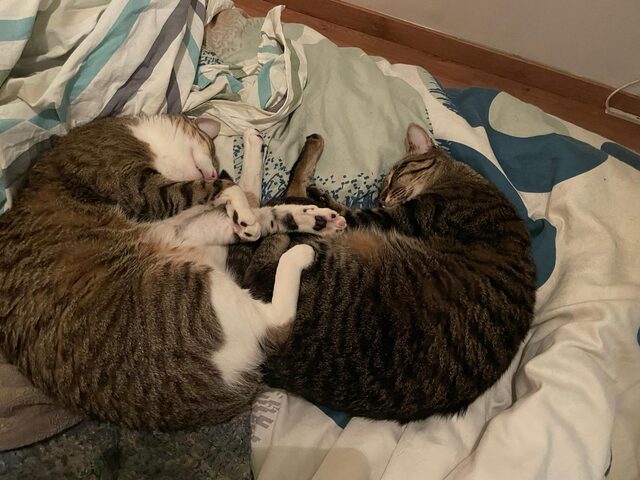 Here they are simulating the merger of a black hole binary. of TED speakers, best-selling authors, and brilliant engineers and data scientists, and I’m proud to be part of it. You can find all my work at OWID on my profile.
By the way: faint signals are buried in the noise, each revealing a hidden story. Click on the signal when you detect it!
Astrophysics
Nobody in my family worked in science: I grew up in Jerez, in the south of Spain, in a humble family of mostly teachers. Through my high school years I was going to piano school and taking painting lessons. But in my final year I suddenly realized I was very good at math and physics, and equally fascinated by astronomy and by the arts. Ultimately, I thought I could do music on the side, but not physics on the side.
So I studied physics at the University of Seville, and a double-degree program took me to the University of Münster, in Germany, where I did my master’s work in nuclear physics. Along the way, I also did a research internship in quantum information theory at the Institute of Photonic Sciences (ICFO) in Barcelona.
I ended up doing my PhD in astrophysics at the Max Planck Institute for Gravitational Physics in Hannover, the institute behind the The night that discovery was announced, a group of us astrophysicists celebrated by chirping like a gravitational-wave signal. The video got picked up by several outlets including The New York Times.
This one didn’t; it’s just for you. in history, which led to the 2017 Nobel Prize in Physics. My PhD advisor, Bruce Allen, did his own PhD with Stephen Hawking, which by the unwritten rules of academic genealogy means that I’m one of Hawking’s academic grandchildren.
My research focused on gravitational-wave astronomy, both theoretical and observational, as a member of international collaborations including LIGO and the European, Parkes, and International Pulsar Timing Arrays. I predicted the boundaries of the gravitational-wave background produced by binaries of black holes, neutron stars, and white dwarfs. I led the project that predicted the properties of the first gravitational-wave detection of supermassive black hole binaries, and discovered that some of them could be detected much further away than previously thought, potentially becoming the most distant astrophysical objects we will ever observe.
After the PhD, I worked as a postdoctoral researcher at the Albert Einstein Institute, Swinburne University of Technology, and Monash University in Melbourne (Australia). During those years I had the privilege of controlling the 64-meter Parkes radio telescope, the dish that relayed the Apollo 11 Moon landing broadcast to the world. Parkes is also the star of one of Australia’s most beloved films, and it’s where I once had the most vivid experience of the Earth rotating under my feet.
Throughout my research career, I presented my work at dozens of conferences, universities, and research centers around the world, giving talks in English, Spanish, and German. You can read my PhD thesis or browse my Google Scholar profile.
Data science
The field of gravitational wave astronomy is dominated by data science. In the case of LIGO, observing these waves involves disentangling tiny waveforms buried in noise. And by tiny I mean waves that typically produce a vibration of a millionth of a millionth of a millionth the size of the detector. In the case of pulsar timing, an observation involves correlating decades of data from different radio telescopes, made of millisecond pulses. Thus, by doing research in this field I had to work with Bayesian and frequentist statistics, but also with common machine learning algorithms.
In 2017 I left academia to apply that craft in industry (a transition I’ve written about in Academia vs. Industry). At GFT I built AI applications for Culture shock is real: one year I was writing equations about black holes, the next I was explaining neural networks to a room full of bankers at Deutsche Bank headquarters. 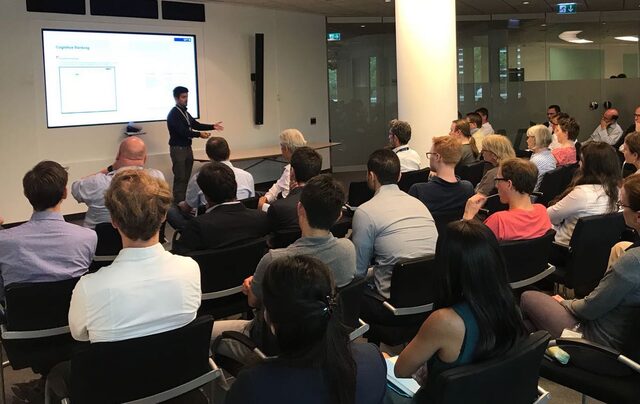 , from natural language processing to computer vision, presenting this work at venues including Google Madrid and the German stock exchange. At Holaluz, a leading Spanish renewable-energy company, I forecast the energy usage of hundreds of thousands of households. At the European Union Intellectual Property Office, I designed and deployed machine-learning systems for semantic search and similarity.
In 2019, the Alan Turing Institute and the University of Warwick selected me as one of two technical mentors for the Data Science for Social Good summer school, where I led data science projects with social impact and taught their ethical implications.
Science communication
In 2022 I founded AltruFísica, a YouTube channel in Spanish that explores how to make the world better using scientific evidence and data. Writing goes way back: I spent a couple of years writing a very long, forever unpublished science-fiction novel about a species evolved from humans, with six fingers on each hand and a strictly plant-based diet. Nothing to click on here, but you can ask my mom for the only printed copy. , film, and edit every episode myself, covering a very diverse range of topics from nuclear weapons to astrology and factory farming. The project received an Amplify creative grant, a program supporting media that spreads ideas to help humanity navigate this century.
Along the way I’ve also trained in filmmaking: I attended a filmmaking summer school at the University of Melbourne and a documentary course at the Australian Film Television and Radio School, collaborated on a documentary with an Emmy-awarded director, and two of my videos have won awards in international contests. You can find some of the videos I’ve worked on on my Video page.
Music
Although I chose science as a career, music has remained a constant throughout my life.
I trained as a pianist at the Jerez School of Music and the Seville Professional Conservatory of Music, and I’ve composed music since I was a child, performing as a soloist and in bands across Europe and Australia. You can listen to some of my piano work on Spotify. I’ve also composed the music for many of my videos, as well as soundtracks for documentaries and short films.
Since 2017 I’ve made music with Mel Brennan. In 2022 we published a studio album, Half Lives, whose songs I arranged, co-produced, and mixed. I also co-produced her Shooting those videos was half the fun. Here is how we spray-painted a potato so it could play a lump of coal in Oh Coal!, and how our living room became an improvised film studio, playing an improvised office, during the COVID lockdown. , including Oceans Rising, which I co-directed, edited, and colored. More on my Music page.
Mission
I believe the most meaningful thing we can do with a life is to reduce suffering, especially extreme suffering, wherever it happens and whoever endures it. But we can’t make progress on what we can’t see. That’s why I’ve spent my career bringing hidden problems into view.
That conviction has consequences in my life. I’ve been vegan since 2015. I’ve pledged 🔸 to donate Money isn’t the only thing I’ve donated: I once gave away 110 centimeters of hair, and there’s a slightly embarrassing video to prove it. to effective charities. I serve on the Board of the Welfare Footprint Institute, supporting the science of quantifying animal welfare. I’ve co-organized Effective Altruism Barcelona, where we’ve run events with high-impact charities. I believe present and future sentient beings in need, human and not, deserve our help.
If any of this resonates, whether you want to talk data, invite me to speak, or figure out how to do more good with your own career, I’d love to hear from you.